DigiHouse
English

TEACHER · ENGINEER · ENTREPRENEUR · RESEARCHER

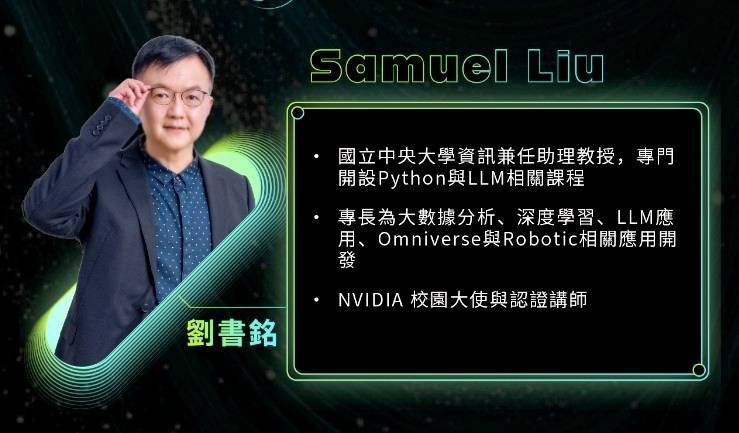
Samuel Liu

From ePuppy to Causal AI—exploring how AI understands people and complex systems.

I am a teacher first, and a hands-on engineer who brings research questions into real products. This is not a résumé list; it is the story of how teaching, entrepreneurship, public R&D and academic research became one continuous journey.

  • University teaching
  • AI and AIoT implementation
  • Product and platform delivery
  • Cross-disciplinary research
Samuel Liu | Adjunct Assistant Professor at NCU and NVIDIA-listed instructor

ONE CONTINUOUS JOURNEY

Not a career switch, but unfinished questions carried forward

From connected devices and electronic pets to AI teaching, multimodal interaction and causal inference, each stage asks how technology can understand context and become a usable system.

  1. 2000s

    CONNECTED PRODUCT

    ePuppy and eBuddy

    Combined Bluetooth, voice, Internet communication and physical interaction before modern AI models were available.
  2. 2006

    GOVERNMENT R&D

    Intelligent care and learning

    A Ministry of Economic Affairs SBIR project turned wireless, voice, Internet and real-time communication into testable R&D.
  3. 2010s–2020s

    PLATFORM DELIVERY

    Research, management and platforms

    Work expanded into data analysis, service platforms, AI planning, and public and university collaboration.
  4. NOW

    TEACHING & RESEARCH

    Bringing AI back to the classroom

    Courses, DLI labs, student projects and collaborative research turn model concepts into reproducible outcomes.

EPUPPY ARCHIVE

Two decades ago, we were already imagining an electronic pet that understood people

The early products explored speech, multiple languages, email reading, Bluetooth, Internet calling and care scenarios. The limit was not the idea, but the computing, sensing and language technology of the time.

TWO RESEARCH DIRECTIONS

Two research tracks, one question: why does behavior happen?

One track studies human–AI interaction; the other studies markets formed by human decisions. Both involve time, multiple data sources, dynamic systems and causal reasoning.

Research direction

ePuppy Reborn Program

Can an AI companion learn emotional and situational context from voice, expression, motion, physiological and environmental signals?
Affective Computing × Multimodal Sensor Fusion × LLM × Embodied AIConsent, data minimization, de-identification and safe interaction come first. A research concept is not presented as a finished product.

Research direction

Financial Transformer × Causal AI

Does an accurate prediction model actually understand why markets change?
Econometrics × Time-Series Transformer × Causal InferenceThis research compares explanatory methods. It is not investment advice and offers no performance guarantee.

Causal & Multimodal AI for Human and Complex Systems—using AI to understand people and the complex systems people create.

TWO DISCIPLINES

Management and electrical engineering are different disciplines—and two sides of implementation

Management research helps explain organizations, decisions and complex systems. Electrical engineering deepens work in sensing, models, devices and human–machine interaction.

2017

PhD, Department of Business Administration, NCU

Completed doctorate connecting management, decisions, nonlinear systems and technology applications.

2026

Doctoral Program, Department of Electrical Engineering, NCU

Admission is confirmed. This is a new electrical-engineering research program, not a second business doctorate.

FROM IDEA TO IMPACT

Beyond advice: advancing a problem until it can be tested

Teaching, research and industry collaboration follow the same basic rhythm, with reviewable results at every stage.

  1. 01

    Industry problem

    Clarify users, context, constraints and the real problem.

  2. 02

    Academic research

    Turn the problem into hypotheses, methods and evidence.

  3. 03

    PoC

    Test technical, data and risk assumptions at minimum scope.

  4. 04

    Prototype

    Connect the model to an interface, process, device or platform.

  5. 05

    Product / transfer

    Evaluate engineering, production, operation and transfer conditions.

  6. 06

    Impact

    Check whether learning, users or organizations actually improve.

PUBLIC REFERENCES

Publicly verifiable references

Only public, review-appropriate links are listed. Private CVs, proposals, pricing, contracts, archives and confidential collaboration materials remain internal.

LEARN OR BUILD TOGETHER

Start with a course or a problem

Students should begin with the course directory. Schools, companies and research teams can share a non-confidential problem statement so we can assess the right depth of collaboration.

  • Courses and talent development
  • AI / AIoT PoC
  • University and public R&D
  • Multimodal and causal AI research
Share a non-confidential need